User Journey Mapping: Turning Friction Points into Growth Opportunities
How to identify customer pain points, trace user pathways, and optimize product flows to turn friction points into user conversion vectors.

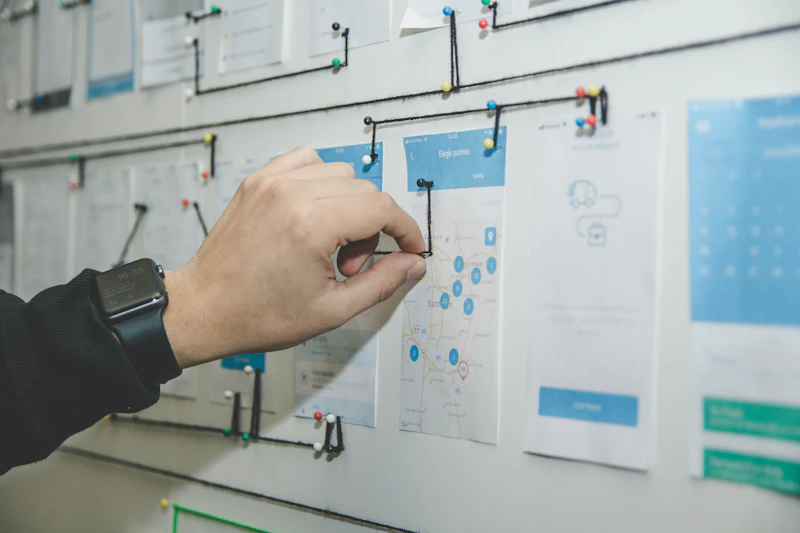
User Journey Mapping: Turning Friction Points into Growth Opportunities
Every interaction a customer has with your product shapes their overall experience. From discovering your website to becoming a loyal customer, users move through a series of steps known as the user journey.
While many teams focus on improving individual screens or features, the real opportunities for growth often lie in understanding the complete journey. A beautifully designed interface can still lose customers if frustration exists between key touchpoints.
User Journey Mapping helps teams visualise how people interact with a product, identify moments of friction, and uncover opportunities to improve conversions, retention, and customer satisfaction.
Rather than guessing why users leave, journey mapping reveals where they struggle and what can be improved.
Let's explore how User Journey Mapping transforms customer pain points into measurable business growth.
What Is User Journey Mapping?
User Journey Mapping is the process of documenting every significant interaction a user has with a product while working toward a specific goal.
Instead of analysing individual screens in isolation, journey mapping looks at the complete experience from the user's perspective.
A journey map typically includes:
- User goals
- Actions taken
- Touchpoints
- Thoughts and emotions
- Pain points
- Opportunities for improvement
The objective is to understand not just what users do, but why they behave the way they do.
Why Journey Mapping Matters
Products rarely fail because of a single major issue.
More often, users encounter several small frustrations that gradually reduce confidence and motivation.
Journey mapping helps teams identify these hidden problems before they significantly impact business performance.
Benefits include:
- Improved user experience
- Higher conversion rates
- Reduced churn
- Better onboarding experiences
- Increased customer satisfaction
- Stronger collaboration across teams
Understanding the complete journey often reveals opportunities that individual screen reviews cannot.
The Stages of a Typical User Journey
Although every product is different, most digital experiences follow a similar lifecycle.
Awareness
     │
     ▼
Consideration
     │
     ▼
Sign Up
     │
     ▼
Onboarding
     │
     ▼
Product Usage
     │
     ▼
Purchase or Upgrade
     │
     ▼
Retention
     │
     ▼
Advocacy
Every stage presents opportunities to delight users - or introduce unnecessary friction.
Understanding Friction Points
Friction points are moments where users experience confusion, hesitation, or frustration while trying to accomplish a task.
These issues may seem small individually, but together they can significantly reduce product performance.
Common friction points include:
- Confusing navigation
- Slow loading pages
- Complicated onboarding
- Long registration forms
- Hidden pricing information
- Poor mobile experiences
- Unclear error messages
- Difficult checkout processes
Every friction point represents a potential opportunity for improvement.
How to Build a User Journey Map
Effective journey mapping combines research, analytics, and customer feedback.
A structured process generally includes the following steps:
- Define the user persona.
- Identify the user's goal.
- List every touchpoint.
- Document user actions.
- Capture user thoughts and emotions.
- Identify pain points.
- Highlight opportunities for improvement.
Journey maps should always be based on real user data rather than internal assumptions.
Example Journey Map
Below is a simplified example of a SaaS onboarding journey.
Stage          Emotion          Pain Point                 Opportunity

Landing Page   😊 Interested     Too much information       Simplify messaging

Sign Up        🙂 Motivated      Long registration form     Reduce form fields

Onboarding     😕 Uncertain      No clear guidance          Add interactive walkthrough

Dashboard      🙂 Curious        Empty first experience     Provide starter templates

Upgrade        😐 Hesitant       Pricing unclear            Improve plan comparison

Retention      😀 Productive     Limited feature discovery  Personalised tips
Visualising the emotional journey helps teams prioritise improvements that matter most.
Turning Friction into Growth Opportunities
Finding friction is only the first step.
The real value comes from converting those insights into measurable improvements.
Examples include:
- Simplifying onboarding to improve activation rates
- Reducing checkout steps to increase conversions
- Improving navigation to reduce support requests
- Adding contextual guidance to increase feature adoption
- Clarifying pricing to improve subscription upgrades
Each improvement removes obstacles that prevent users from achieving their goals.
Using Data to Validate Journey Maps
Journey maps should be supported by evidence rather than opinions.
Useful research methods include:
- User interviews
- Usability testing
- Session recordings
- Heatmaps
- Product analytics
- Customer surveys
- Support tickets
Combining qualitative and quantitative research provides a more complete understanding of the customer experience.
Journey Mapping Across Teams
User Journey Mapping isn't only valuable for designers.
Successful journey maps align multiple teams around a shared understanding of customer needs.
Different teams benefit by:
- Design improving usability
- Product prioritising valuable features
- Engineering reducing technical friction
- Marketing improving acquisition messaging
- Customer Success reducing support requests
When everyone understands the same customer journey, product decisions become more consistent.
Common Mistakes to Avoid
Many journey maps fail because they focus on assumptions instead of evidence.
Avoid these common mistakes:
- Mapping internal processes instead of user experiences
- Ignoring emotional responses
- Using fictional pain points without research
- Creating maps that are never updated
- Focusing only on successful journeys
- Ignoring mobile users
A journey map should evolve as user behaviour and products change.
Measuring Success
After improving friction points, teams should measure the impact using clear business metrics.
Common KPIs include:
- Conversion rate
- Task completion rate
- Customer retention
- Feature adoption
- Net Promoter Score (NPS)
- Customer Satisfaction Score (CSAT)
- Support ticket volume
- Time to complete key tasks
Journey mapping becomes valuable when it leads to measurable improvements rather than static documentation.
Best Practices for Effective Journey Mapping
To create journey maps that drive meaningful results:
- Base every decision on real user research.
- Focus on specific personas and goals.
- Document user emotions alongside actions.
- Identify measurable friction points.
- Prioritise improvements with the greatest business impact.
- Review and update journey maps regularly as products evolve.
The best journey maps remain living documents rather than one-time exercises.
Final Thoughts
User Journey Mapping provides one of the clearest ways to understand how customers experience a product from beginning to end.
By identifying friction points, validating them with research, and continuously improving the experience, organisations can increase conversions, strengthen customer loyalty, and create products that genuinely solve user problems.
The most successful companies don't optimise isolated screens - they optimise complete journeys.
Every moment of friction is an opportunity to improve the experience, build trust, and create sustainable business growth.
Frequently Asked Questions
What is User Journey Mapping?
User Journey Mapping is the process of visualising every interaction a user has with a product to understand their goals, actions, emotions, pain points, and opportunities for improvement.
Why is User Journey Mapping important?
It helps teams identify friction points, improve user experience, increase conversions, reduce churn, and make product decisions based on real customer behaviour.
What are friction points in a user journey?
Friction points are moments where users encounter obstacles such as confusing navigation, lengthy forms, poor onboarding, or slow performance that make completing tasks more difficult.
How do you identify user journey friction?
Teams typically combine analytics, usability testing, user interviews, heatmaps, session recordings, surveys, and customer support data to uncover friction points.
Who should use User Journey Maps?
Designers, product managers, developers, marketers, and customer success teams all benefit from journey maps because they provide a shared understanding of the customer experience.
Key Takeaways
- User Journey Mapping focuses on the complete customer experience rather than individual screens.
- Friction points often reveal the biggest opportunities for business growth.
- Journey maps should combine user actions, emotions, pain points, and opportunities.
- Research and analytics are essential for creating accurate journey maps.
- Small improvements across multiple touchpoints can significantly improve conversions and retention.
- Journey mapping aligns design, product, engineering, marketing, and customer success teams.
- The most effective journey maps evolve continuously as user needs and products change.